SOURCE: The Six Conditions for Bringing Your Whole Intelligence Into the Room


In the last edition, I introduced Whole Intelligence — the idea that AI hasn’t created a new threat so much as it’s exposed an old, unfinished reckoning: we spent three centuries valuing only the half of human intelligence that a machine could eventually copy, and disqualified the rest.
The question I heard back from several of you, in different words, was some version of: I believe this. What do I actually do with it?
That’s a fair and important question, and it deserves a real answer rather than another abstraction.
What comes to mind is a woman I’ve sat across from many times, in one form or another. She is exceptional at her job. She can read a room in seconds, defuse a conflict before it fully forms, and hold a long list of competing priorities without dropping one. And she has almost no idea she is doing any of this from behind a mask so old and so well-fitted that she stopped registering it as separate from her face. She is bringing perhaps sixty percent of herself into any given room — the sixty percent that was rewarded, the sixty percent that was safe to show. The rest is not gone. It is simply not being asked for, so it waits, and the waiting is what exhausts her more than the work does.
This is what it actually looks like to operate on partial intelligence. Not incompetence — the opposite. Extraordinary competence, running on a fraction of the fuel available to her.
So, in this edition, I want to introduce the framework underlying everything I actually teach — the six conditions that let a person bring the whole of her intelligence into a room, instead of just the fraction that’s been trained, rewarded, and mistaken for the whole self.
I call it SOURCE.
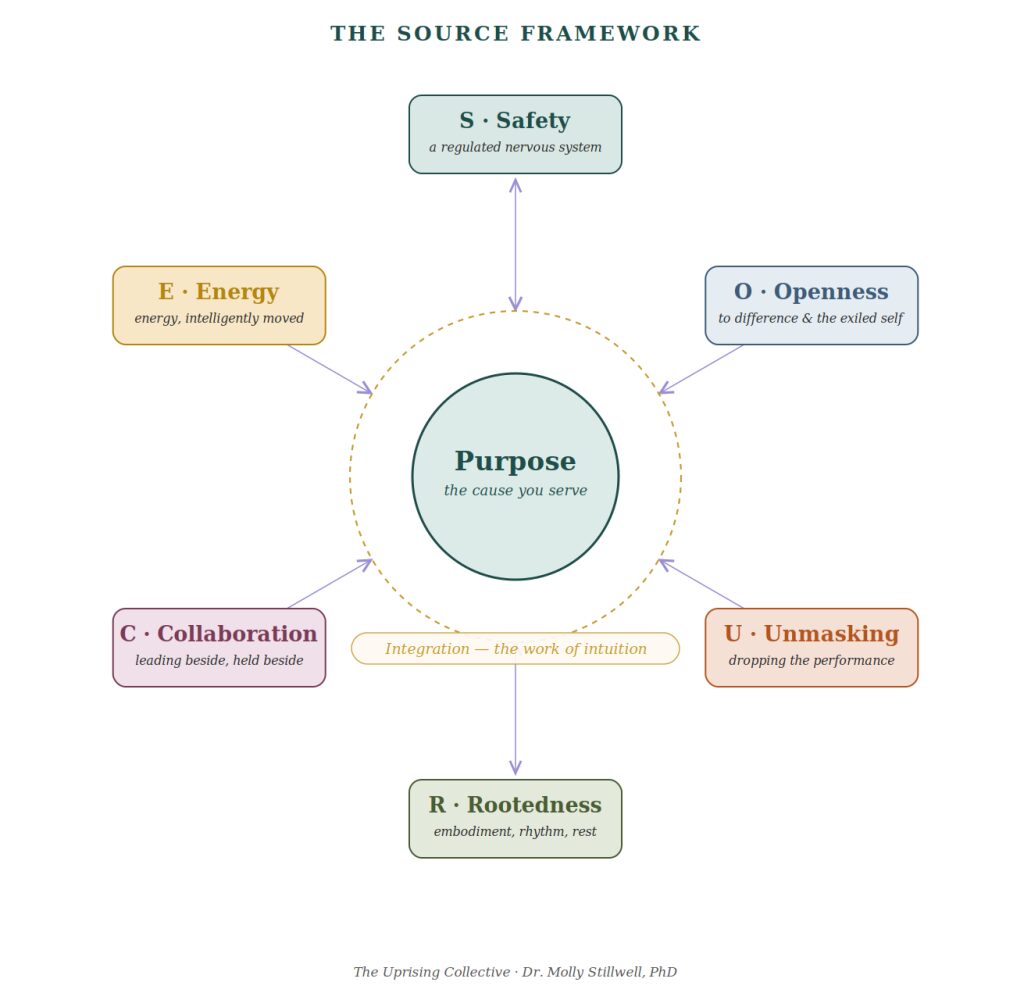
The Architecture
SOURCE isn’t six equal, interchangeable pillars sitting in a row. It has a structure, and the structure is the point.
Purpose sits at the center — not as a seventh item on the list, but as the thing the other six exist to serve. Without a purpose orienting them, safety becomes mere comfort, openness becomes mere agreeableness, energy becomes motion without direction. Purpose is what turns six conditions into a single coherent instrument instead of six separate virtues competing for your attention.
And Integration runs through all of it as the membrane, the connective tissue that keeps the six conditions from becoming six disconnected skills you perform separately depending on the room. Without integration, you can have real safety in one context and none in another — openness with your team and defensiveness at home, unmasked with your closest friend and armored in every meeting that actually determines your career. Integration is what makes SOURCE a whole way of being rather than a set of situational tools you reach for selectively.
The Six Conditions
S — Safety. The nervous system grounds everything else that is built on. This is not the absence of risk — it’s the presence of enough regulation that risk can be metabolized rather than defended against. Without it, none of the other five are available to you. You cannot be open, unmasked, or energetically directed from a body that is bracing. Every other condition on this list is, in some sense, downstream of this one.
O — Openness. To difference, to other perspectives, to the parts of yourself you’ve exiled along the way, to what you don’t yet know and cannot yet prove. This is diversity, lived at the individual level, before it is ever a policy or a hiring target. A woman who is closed to her own contradictions will struggle to genuinely welcome contradiction in the people around her.
U — Unmasking. Dropping the performance long enough to let yourself actually be met. This is the specific exhaustion so many high-achieving women describe without quite having language for it — performing confidence at work, performing togetherness at home, performing certainty in rooms where she is quietly unsure. Unmasking is not a single dramatic reveal. It is the accumulated relief of no longer maintaining two versions of yourself at once.
R — Rootedness. Embodiment. Bringing what you know into the body so it becomes stable and lived, not just intellectually understood and constantly re-argued. This is where the somatic work lives — the body as the actual site of change, not a footnote to it or a wellness add-on after the real work is done. An insight that has not been rooted in the body tends to evaporate the moment the old conditioning reasserts itself under pressure.
C — Collaboration. Leading from beside rather than in front of. A fluid, relational model of leadership that redefines failure as information rather than exposure, and lets everyone in the room be a leader within their own scope, rather than concentrating authority and risk in one performed role at the top. This is not the absence of hierarchy. It is the hierarchy that has stopped requiring anyone to shrink.
E — Energy. Directing your energy with intention, so aligned action builds real momentum instead of scattering across everything that asks for it. This is the condition that turns the first five from an internal state into a visible, external impact — the difference between having done the inner work and actually moving something in the world because of it.

Why This Isn’t Just a Nicer Version of “Be Yourself”
I want to be precise about why this matters beyond feeling good to read, because I think the actual mechanism here is more interesting — and more defensible — than most leadership content gives it credit for.
In another article of mine, I corrected a claim I’d been ready to make casually: that diverse teams simply perform better. The research doesn’t actually support that as a clean, standalone fact — the popular version of that claim has failed serious replication attempts. What more rigorous research shows instead is that diversity produces better outcomes only when genuine psychological safety is present. Without it, diversity’s benefits don’t reliably appear, and can even increase friction.
Read that finding again next to the first letter of SOURCE. Safety is not a soft, secondary condition sitting alongside diversity and inclusion efforts. It is the mechanism that determines whether a difference in a room ever converts into anything real. You cannot innovate from a nervous system that doesn’t feel safe. You cannot lead as someone you are still pretending to be.
The six conditions in SOURCE are not a nice sentiment — they are, as far as the evidence shows, the actual precondition for the outcomes every organization says it wants.
Why This Matters More Right Now Than It Did Five Years Ago
This is also where SOURCE and Whole Intelligence meet directly. If the last several centuries taught us to value only the analytical, output-producing half of human intelligence, then most professional environments were never actually built to hold six full conditions like these. They were built to reward Energy — output, momentum, visible motion — while treating Safety, Unmasking, and Rootedness as personal problems to be managed quietly, off the clock, on your own time.
AI is what makes this newly urgent rather than merely nice to consider. The analytical half of intelligence — the half most workplaces spent generations optimizing for — is precisely the half a machine is now beginning to do faster and more cheaply than any of us.
What remains genuinely, irreplaceably human is everything SOURCE names: the nervous system’s capacity for real safety, the willingness to stay open under uncertainty, the courage to unmask, the wisdom rooted in a body rather than a spreadsheet, the relational skill of collaboration, and the discernment to direct energy toward what actually matters. This was always the deeper work. It has simply become more urgent that we do this work now.

How It Moves
SOURCE works two ways at once, which is part of why I built it this way.
As a thesis, it’s the six conditions under which a person brings their whole intelligence to their life and work — something to understand and recognize in yourself, wherever you currently are.
As a journey, it sequences from the inside out: Safety, then Openness, then Unmasking, then Rootedness, then Collaboration, then Energy. You establish enough safety to open. You open up enough to stop performing. You root what you’ve uncovered in the body, so it holds. Only then does collaboration become genuine rather than another performance, and only then does energy move with real direction instead of scattering.
You cannot innovate from a nervous system that doesn’t feel safe. And you cannot lead as someone you are still pretending to be.
Where You Go From Here
This is the shape of it — the architecture and the six conditions, so you have language for something you’ve likely already been sensing in your own leadership, even before it had a name.
What I haven’t given you here, on purpose, is the part that actually requires more than reading: finding out where you personally sit within these six right now — where you’re genuinely strong, where you’re bracing without realizing it, where the mask has been on so long it stopped feeling like a mask at all. That’s not something an article can do for you. It’s the work itself.
If you want to find out where you actually stand, the SOURCE Assessment is built for exactly that — a short, real reflection that shows you which of the six conditions are already solid in your leadership and which ones are quietly running on empty. It’s free, no email or sign-up required, just your time and willingness to explore this idea further.
And if you already know you’re ready to go deeper than a self-assessment — to actually work through what you find, with someone alongside you — I’d love to talk.
and visit theuprisingco.com to explore everything The Uprising Collective offers
Molly Stillwell, PhD
Founder, The Uprising Collective · theuprisingco.com


